
The 7 Senses of the Ocean’s Greatest Predators
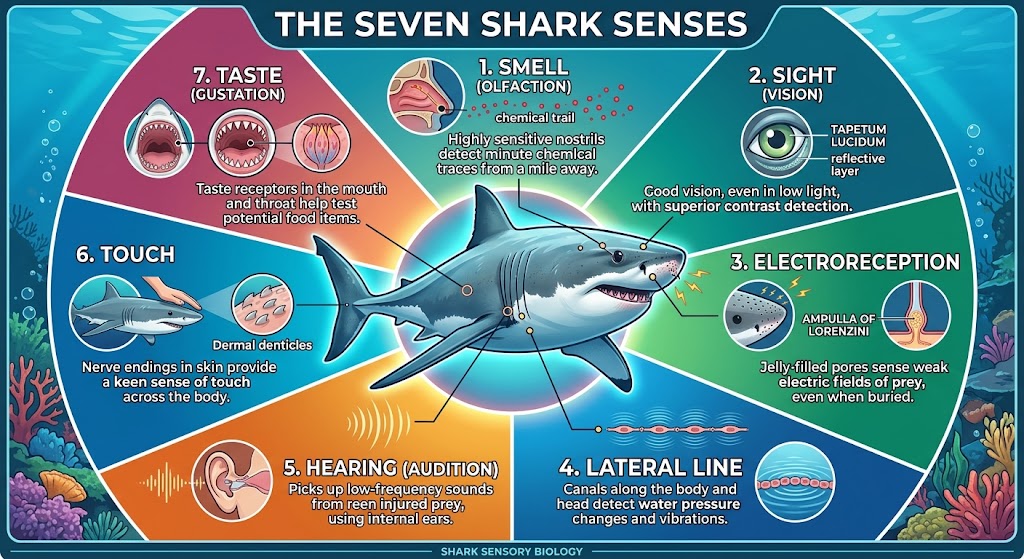
We know about our five senses, but sharks have six- even seven when indirect pressure is considered! Most sharks have keen senses that allow them to track prey, predators, and mates at varying distances
Sharks are often misunderstood as simple eating machines, but they are actually highly evolved, complex animals perfectly adapted to their environment. They experience the underwater world through an incredible array of seven distinct senses.
Use this guide to learn how sharks hear, see, smell, and feel their way through the ocean!
1. Hearing (Audition)
Sharks have excellent hearing and rely on it as their first warning system or dinner bell. They are especially sensitive to low-frequency, pulsed sounds, which mimic the noises made by wounded or struggling fish. Their ears are located entirely inside their heads, visible only as two tiny pores behind their eyes.
- Effective Range: Up to 1 to 2 miles (1.6 – 3.2 kilometers), making it their longest-range sense.
- Featured Species: Lemon Shark (Negaprion brevirostris). Marine biologists have extensively studied Lemon sharks and found they have incredible directional hearing, able to pinpoint the exact location of a struggling fish from hundreds of yards away in a matter of seconds.
2. Smell (Olfaction)
A shark’s sense of smell is legendary. Water constantly flows through their nares (nostrils located under the snout), which are used exclusively for smelling, not breathing. This allows them to detect minute concentrations of biological chemicals, like fish extracts, amino acids, and blood in the water.
- Effective Range: Up to several hundred yards to 1 mile (depending on ocean currents carrying the scent).
- Featured Species: Great White Shark (Carcharodon carcharias). The Great White has the largest olfactory bulb relative to its brain size of any shark. It can detect a single drop of blood in an Olympic-sized swimming pool (about 1 part per 10 billion).
3. Pressure & Vibration (The Lateral Line)
Sharks possess a unique sensory system called the lateral line, a row of fluid-filled canals running along both sides of their body from head to tail. These canals contain microscopic hair cells that detect tiny shifts in water pressure and vibrations, allowing the shark to “feel” the movement of creatures around them—even in total darkness.
- Effective Range: Up to 100 to 300 feet (30 – 100 meters).
- Featured Species: Blind Shark (Brachaelurus waddi). Despite its name, this shark isn’t actually blind, but it often retracts its eyeballs and closes its thick eyelids when removed from water or navigating rocky tide pools. It relies heavily on its lateral line to effortlessly navigate tight, turbulent spaces without bumping into anything.
4. Sight (Vision)
Contrary to popular myth, sharks have excellent vision. Their eyes are structurally similar to human eyes but are adapted to the marine environment. Many sharks possess a tapetum lucidum—a reflective layer behind the retina that bounces light back through the eye, giving them superior night vision that is highly effective in murky or dark waters.
- Effective Range: Up to 50 to 100 feet (15 – 30 meters), highly dependent on water clarity.
- Featured Species: Bigeye Thresher Shark (Alopias superciliosus). This deep-water hunter has enormous, upward-looking eyes (up to 4 inches across). These massive lenses allow the shark to hunt in the “twilight zone” of the ocean, silhouette-spotting prey against the faint light filtering down from the surface.
5. Electromagnetivity (Ampullae of Lorenzini)
Sharks have a “sixth sense” granted by jelly-filled pores scattered across their snouts called the Ampullae of Lorenzini. These pores detect the ultra-faint electrical fields generated by the muscle contractions and beating hearts of all living animals. This sense is also believed to help sharks navigate using the Earth’s magnetic field.
- Effective Range: Very close range; inches up to 3 feet (about 1 meter).
- Featured Species: Scalloped Hammerhead (Sphyrna lewini). The iconic, wide-sweeping head of the hammerhead (the cephalofoil) is packed with these electrosensory pores. The shark sweeps its head back and forth over the sea floor like a metal detector, sensing stingrays buried entirely out of sight beneath the sand.
6. Touch (Somatosensation)
Sharks have a network of nerve endings under their skin, particularly around their mouth and snout. However, their skin itself is covered in dermal denticles (tiny, tooth-like scales), making it tough and armor-like. They use tactile feedback to interact with their environment, gauge the physical nature of prey, and communicate during mating.
- Effective Range: Direct contact (0 meters).
- Featured Species: Epaulette Shark (Hemiscyllium ocellatum). This remarkable reef shark uses tactile feedback from its muscular pectoral and pelvic fins to actually “walk” across the coral reef and tide pools. Its highly sensitive touch allows it to navigate jagged coral out of the water at low tide.
7. Taste (Gustation)
Sharks have taste buds, but they aren’t located on a tongue like ours; they are concentrated inside their mouths and throats. Because they cannot use their fins to pick things up, a shark’s bite is often an investigatory “taste test.” If an object doesn’t taste like their natural, high-fat prey, they will usually spit it out.
- Effective Range: Direct contact (Inside the mouth).
- Featured Species: Tiger Shark (Galeocerdo cuvier). Often nicknamed the “garbage cans of the sea” because they will bite almost anything. However, their sense of taste is actually what saves them; they use their taste buds to evaluate whether the strange object they just bit (from a sea turtle to a piece of driftwood) is nutritious enough to swallow, often rejecting non-food items after a quick taste.
Provided by Shark Stewards – Dedicated to saving sharks and protecting the oceans.