December 01, 2026 by David McGuire
A July 31, 2026 paper “Global trade responses to shark finning regulations” evaluating shark finning regulations concluded that shark finning regulations did not produce statistically significant changes in countries’ shark exports, imports, or domestic consumption. This article has brought misdirected criticism to shark conservation efforts and their efficacy over two decades to address the alarming decline in shark populations as a result of overfishing and the indisputable demand of the shark fin trade driving global shark fishing. Published in the journal Nature Communications, by Sara Orofino of The Nature Conservancy as co-lead author and Gavin McDonald of UC Santa Barbara’s emLab as senior author, has without intention, disappointed shark conservationists working to protect sharks from over harvesting.
It is important to understand that the authors examined trade and is not a count of all sharks killed. However, the authors findings do not consider shark fins across all shark fisheries including illegal, unreported, and unregulated (IUU) fishing, or the merit from other shark conservation efforts. The original shark -finning bans were implemented in the 1990s to address the cruel and unsustainable act of killing a shark solely for their fins as a valuable product to sate the demand for shark fin soup. The first federal law to ban shark finning in the United States was the Shark Finning Prohibition Act, which was signed into law by President Bill Clinton on December 21, 2000. Despite this loopholes existed, and most countries continued to kill sharks for their fins with impunity driven by the high profit for the for the fin and low return for shark meat.
That distinction matters immensely for how the findings are understood. Because fisheries data and trade databases often lump shark fins in as dried seafood or co-products, the catch and trade data do not account for sharks that are caught, finned, and discarded at sea. Fewer sharks appearing in global market data does not necessarily mean fewer sharks are dying; the regulations may have simply shifted the trade dynamics or caused fishers to discard their catch rather than bring it to port.

The Decline of Offshore Sharks Studies tracking global marine populations have shown that fewer fins in the global market are coming from offshore, pelagic sharks—largely because those populations have already been decimated. Over the last 50 years, global oceanic shark and ray populations have plummeted by more than 70% due to severe overfishing.
The paper notes that global shark mortality has continued to rise despite more regulation. However, that doesn’t give critics of shark fining and shark fin regulations reason to give up and discard these regulations. Finning regulations can take several different forms. Some, like in the Western and Central Pacific Fisheries Commission (WCPFC) require fishermen to land sharks intact with their fins still attached. Others like in the EU require fins to be secured to the carcass, or have fin-to-carcass ratios.
According to an independent review commissioned by the Marine Stewardship Council (MSC) that investigated the 43 nations catching the largest amount of sharks globally. The MSC reports that 21 of those top fishing nations have a general finning ban in place. Only 19 of those nations enforce a strict “fins naturally attached” policy. Requiring fins-attached regulations under Regional Fisheries Management Organizations like ICCAT in the Atlantic, to use the strictest landing requirements will reduce the number of sharks caught, and make for better record keeping.
Positive Steps and Protections Despite the complexities of global trade data, real, positive steps are actively protecting vulnerable species and reducing catch mortality:
- CITES and ESA: The oceanic whitetip shark, once heavily targeted for its large fins, recently achieved a historic victory at the CITES CoP20 summit, where it was granted full Appendix I listing—the highest standard of international trade protection. In the United States, the species is also protected under the Endangered Species Act (ESA), which mandates strict conservation and management efforts.
- Catch Reduction: Regional fisheries are increasingly implementing gear restrictions to reduce shark bycatch. Strategies like banning wire leaders (allowing sharks to bite through the line and escape) and mandating the use of circle hooks instead of J-hooks have proven effective in lowering the mortality rates of sharks accidentally caught by commercial longlines.
Shifting Tides in Asia
Demand is also changing in the regions that have historically driven the fin trade. In Asia, there are measurable declines in both the import of shark fins and the consumption of shark fin soup:
- Hong Kong: Once the undisputed hub of the global fin trade, Hong Kong has seen its shark fin imports drop dramatically by 50% to 70% over the last decade and a half.
- Singapore: In Singapore, numerous hotels and dining establishments have completely removed shark products from their menus in response to changing consumer ethics and awareness.
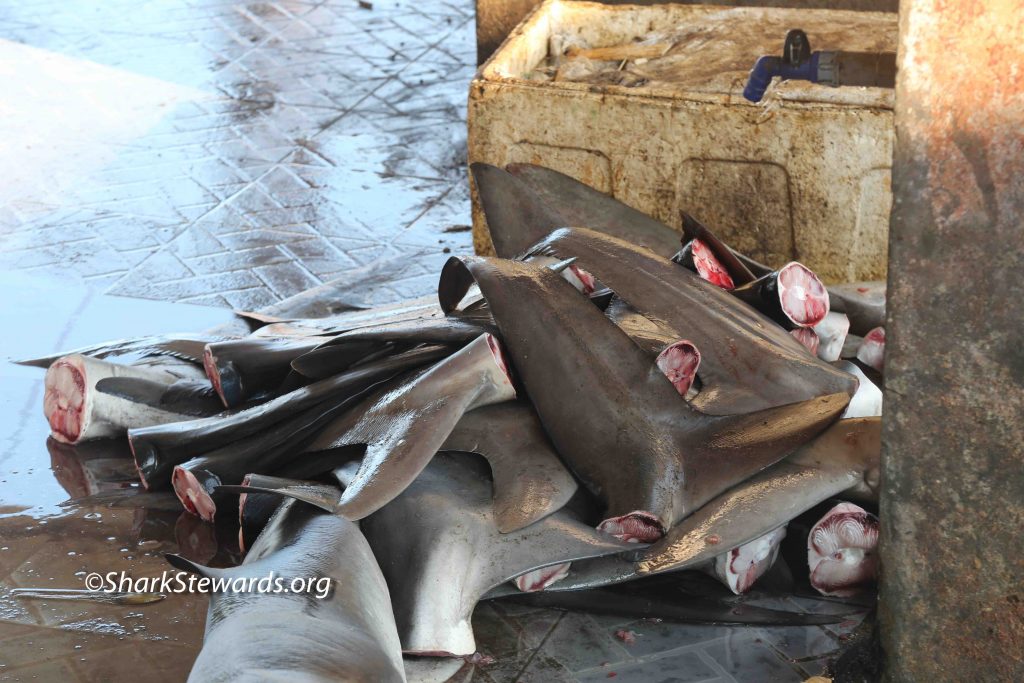
Shark Fin Regulations
The Burns et. al. paper analyzed shark fin landings and trade from legal fisheries using the ARTIS database. Because this framework relies strictly on documented government and trade data, it inherently only captures the legal, above-board market. Because the study only tracked legal trade, it did not capture at-sea discards e.g. sharks that are illegally finned at sea and have their bodies dumped overboard. Because these animals are never brought to port, they never enter official customs databases and are completely invisible in legal trade statistics. The paper also does not consider the black market e.g. Illegal, unreported, and unregulated (IUU) shipments of shark fins intentionally smuggled past customs or mislabeled to avoid detection.
With estimates of as much as 20% of all trade in fish associated with IUU fishing, the figures of shark catch and shark fin trade are largely underestimated. Although well intentioned, shark finning bans may not be working, but awareness through directed campaigns by NGOS, especially targeting the shark fin consumers, and laws regulating shark fin imports and exports have helped protect some populations and species of sharks.
USA shark fin exports dropped to zero as a direct result of the Shark Fin Sales Elimination Act, which was signed into law in December 2022. This law made it federally illegal to buy, sell, or transport shark fins in the U.S. or its territories. For context, while the U.S. had already stopped importing shark fins in 2019, it was still exporting them until this comprehensive ban took effect. According to the latest NOAA 2024 Shark Finning Report to Congress, there were zero shark fin exports from the United States in 2023.
The U.S. is still a large shark fisher and exporter of shark meat, exporting over 6.4 million pounds in 2023. However, the fins themselves are no longer legally exported. Until NOAA releases the 2025 Shark Finning Report to Congress detailing the 2024 export volumes, we cannot say if the total volume exceeded the 6.47 million pounds exported in 2023. France, Thailand, and Mexico remain the primary destinations for the shark meat that does leave U.S. ports.

Focusing on Fisheries Regulation
While global shark mortality has seen an overall increase driven heavily by coastal fisheries, empirical data and peer-reviewed studies show concrete reductions in offshore pelagic fisheries, alongside measurable successes using bycatch mitigation gear. A landmark 2024 analysis published in Science (Worm et al.) evaluated global shark fishing mortality trends from 2012 to 2019. While the researchers observed a 4% increase in shark mortality in coastal waters, they documented a 7% decrease in pelagic (offshore) shark mortality over the exact same period. This indicates that international treaties, Regional Fishery Management Organization (RFMO) regulations, and high-seas management efforts are yielding tangible conservation benefits for pelagic populations.
Transitioning the materials used in commercial longline gear significantly lowers bycatch. According to a 2022 NOAA Fisheries report, replacing steel wire leaders with monofilament leaders in Pacific fisheries reduced shark bycatch by approximately 40%. Monofilament allows incidentally caught sharks to bite through the line and free themselves much faster than they can with steel wire. Acting on this data, fleets like the Hawaii deep-set longline fishery, through the Hawaii Longline Association, have successfully implemented voluntary transitions away from wire leaders to protect vulnerable species like oceanic whitetip and silky sharks.
Changing hooks from J shaped hooks to circle hooks can similarly reduce bycatch-related mortality. Research, including a foundational 2012 study (Godin et al.) and technical reviews by the International Commission for the Conservation of Atlantic Tunas (ICCAT), has analyzed the physiological impact of hook shape on elasmobranchs. Studies consistently demonstrate that replacing traditional J-hooks with large circle hooks significantly decreases “at-haulback” mortality for numerous shark species, including shortfin makos. Circle hooks dramatically reduce fatal gut-hooking, promoting jaw-hooking instead, which vastly improves the post-release survival rates for sharks accidentally caught on commercial lines.

Marine Protection Can Protect Sharks
More than a dozen nations have moved beyond regulating shark fishing practices and have banned commercial shark fishing and fin possession entirely across their entire Exclusive Economic Zones (EEZs). Palau established the world’s first shark sanctuary in 2009 prohibiting all shark fishing in their EEZ. Countries like French Polynesia, the Maldives, Honduras, Bahamas and the Marshall Islands operate large sanctuaries where targeting sharks is a major maritime crime. The USA has the largest shark protected area in the world is the Papahānaumokuākea Marine National Monument and Sanctuary Encompassing over 500,000 square miles. This marine protected area prohibits fishing in a region northwest of Hawaii protecting reef sharks, hammerhead sharks, and many migratory species including silky, blue and oceanic whitetip sharks. However, this protection is currently being considered under the Trump Administration by illegally opening the Sanctuary to commercial fishing which would harm protected sharks.

Hope for the Future Sharks are the vital architects of the ocean. As apex predators, they maintain the balance of the marine food web, keeping prey populations healthy and protecting critical habitats like seagrass beds and coral reefs. While global trade regulations still need to be optimized, the localized victories, international trade bans, and dropping consumer demand prove that the tide is turning.
You can be a part of this positive momentum. By supporting organizations like Shark Stewards, advocating for stronger local marine protections, and choosing sustainable seafood, we can ensure these magnificent animals continue to thrive in our oceans.
Burns, E.S., Orofino, S., Wang, K. et al. Global trade responses to shark finning regulations. Nat Commun 17, 6821 (2026). https://doi.org/10.1038/s41467-026-75625-1
Pacoureau, N. et al. Half a century of global decline in oceanic sharks and rays. Nature 589, 567–571 (2021).
Worm, B. et al. Global shark fishing mortality still rising despite widespread regulatory change. Science 383, 225–230 (2024).
Cardeñosa, D. et al. Two thirds of species in a global shark fin trade hub are threatened with extinction: Conservation potential of international trade regulations for coastal sharks. Conserv. Lett. 15, 12910 (2022).
Agnew, D. J., Pearce, J., Pramod, G., Peatman, T., Watson, R., Beddington, J. R., & Pitcher, T. J. (2009). Estimating the worldwide extent of illegal fishing. PLoS ONE, 4(2), e4570. doi.org