
California Fish and Game Commission Passes Emergency Regulationʻs for Fishing White Sharks and Increase Public Safety
June 17, 2026
Shark Stewards has been tracking shark catch in Southern California in social media and documented that fishermen are catching white sharks under the guise of fishing for other sharks, despite its illegality under California law AB 2109. Under California Code of Regulations (Title 14, § 28.06) and Fish and Game Code Section 5517, white sharks may not be taken or possessed at any time, except with a special scientific or educational purposes.
On June 17, the California Fish and Game Commission unanimously voted to approve an emergency regulation to strengthen fishing gear restrictions to improve public safety and reduce large shark catch at California beaches and piers.
This emergency regulation will reduce hook size and prohibit wire leaders up to 1000 miles from shore. However, the Department and Commission did not include Shark Stewardʻs recommendations to ban chum and live bait and the use of drones that transport bait to deeper waters. We are now asking the CAFG to make these regualtions permanent past the December 2026 emergency regulation period.
This is an improvement that will help Fish and Wildlife officers enforce shark fishing near public piers and beaches. However, it is not a complete solution to impacts on sharks or completely increase public safety. We will be monitoring white shark -human interactions and shark fishing at public piers and beaches during the emergency regulation period, and pursue permanent protective language during the Standard Regulatory period following December 2026.
Background
A loophole in AB2109 makes it illegal to fish for sharks only “when white sharks are near.” This loophole gives fishermen targeting white sharks an out, while also allowing fishermen to harm a protected species with impunity despite catch and release practices. Social media and the news rewards this illegal behavior. Since AB 2109 came into law we have documented more than thirty instances of fishermen catching large sharks on social media. Dead white sharks have washed up on beaches with evidence of fishing gear and damage at Torrey Pines , Carlsbad and Santa Cruz. The shark in the instagram post below by Terrafirmtackle was caught twice and shows clear signs of gill damage.
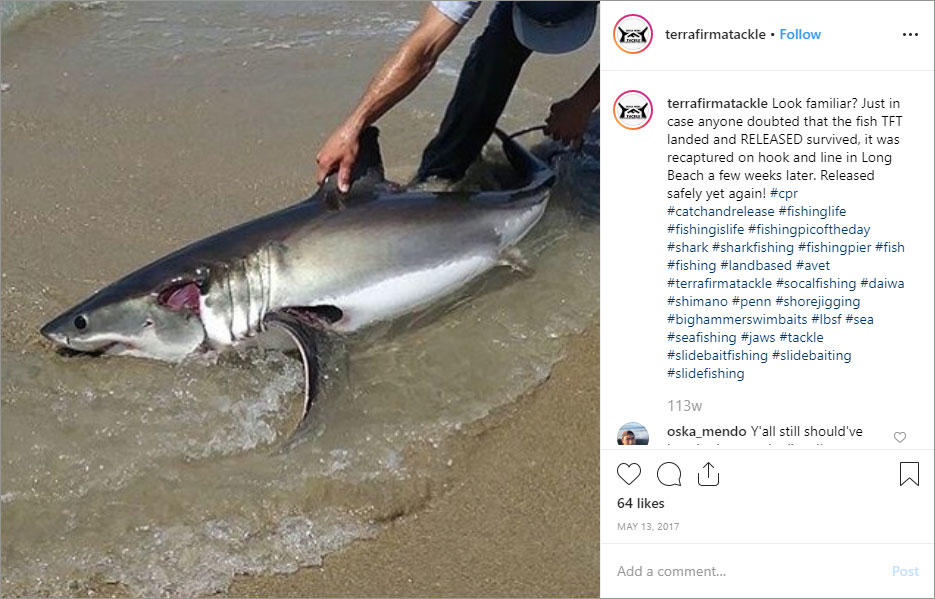
Image White shark caught, released and recaptured Terrafirmatackle Instagram
It is strictly illegal to intentionally fish for, catch, or possess white sharks in California waters. Governed by the California Department of Fish and Wildlife (CDFW), these protections require anglers to immediately release any white shark that is accidentally hooked, without removing it from the water. White sharks Carcharodon carcharias are classified as Vulnerable worldwide by the International Union for the Conservation of Nature, and are protected from fishing under California and federal law. These sharks are prohibited in commercial and recreational fishing, yet sports fishermen catch these and other sharks at public piers and beaches, particularly juvenile and sub adult sharks nearshore.
The news story of the young man widely celebrated on the news and social channels for releasing a white shark on April 10 at the Hermosa Pier, followed by a targeted team effort Saturday is a glaring example of this loophole. The excuse that they thought they were catching Mako sharks is absurd. We request an investigation into this incident and citations issued to the perpetrators. A witness La Playita restaurant owner Harold Cohen observed five sharks being caught. With over 20 sharks reported caught it is likely that one shark was caught and released more than once. Fighting a shark and bringing it to the pier level to cut the line exhausts the animal and threatens its survival. These sharks are gaffed to raise them and cut the line, injuring sensitive gills or rostrum. Leaving hooks and lines in the jaw impair their feeding and risks infection.
Attracting and catching large sharks nearshore also puts the public safety at risk. On the morning of Saturday July 5, 2014, distance swimmer Steven Robles was bitten by a 7-to-10-foot juvenile white shark while swimming off the Manhattan Beach Pier in California. The shark, which had been hooked by a fisherman for 40 minutes before the line was cut. The agitated shark bit Robles in the torso and hand before releasing him, causing extreme injury. Other near misses have been documented with sharks passing close beneath surfers at public beaches where fishing is occurring.
Image CBS News story of attack on swimmer Steven Robles, Mahatten Beach Pier
Shark Stewards has petitioned the California Department of Fish and Wildlife and the Fish and Game Commission to increase regulation for the public safety and protect threatened species.
We support a regulation for all public piers and beaches in California that will:
prohibit chum and live bait in the water;
limiting hook size to no greater than 1/0;
prohibit heavy wire or kevlar leaders;
prohibiting line strength greater than 60 test;
prohibit mechanical gaffs on piers;
prohibit the use of drones to place bait offshore;
Banning nearshore shark attractant (not just white sharks), drone fishing and banning shark fishing entirely has been applied in towns in Florida and South Carolina to protect the public safety. As a leader in shark and marine conservation, California can demonstrate sound policy that allows recreational and subsistence fishermen to fish safely and responsibly.
The Commission passed regulations that will limit hook size to 1.5 inches and prohibit wire leaders on public piers and beaches 1000 miles from shore.