
By David McGuire
07/01/2026
In June, NOAA’s National Weather Service officially reported the onset of an El Niño pattern supporting predictions of an extreme weather disruption dubbed the “Super El Niño” in fall and winter of 2026/2027. During an El Niño event, the Pacific jet stream is pushed southward, bending across California and the desert Southwest instead of its normal route over the Pacific Northwest. This shifts storm tracks directly over California, bringing stronger, southerly to southwesterly winds and increasing the frequency of heavy rain and atmospheric river events in North America. The weather event also increases seawater temperatures, displaces currents and marine populations, and impacts the coastal upwelling responsible for increasing productivity on the coastal marine ecosystem. So what can we expect this fall in the Gulf of the Farallones and along the Bay Area Coastline?
El Niño events significantly alter local coastal wind patterns along the north and central California coast by weakening the spring/summer northwesterly flows, reducing upwelling events and biological productivity. Upwelling is a process in which strong winds push surface waters out, allowing for colder, nutrient-rich deep water to rise and replace them. These warm events can have long-lasting repercussions, depleting nutrients in the surface waters that coastal species and marine life depend upon. Warm surface waters increase stratification and limit vertical mixing with colder water, creating less favorable conditions for phytoplankton growth. Invertebrates like copepods and krill rely on upwelling events to flourish. Krill, a type of mysid shrimp, is another marine invertebrate and the primary food source for Blue and Fin whales, and other more rare filter-feeding species, as well as diving birds like common murres. This vastly abundant food resource in normal years also crashes causing these whales to relocate to feed. These seasonal blooms in turn support forage fish like anchovies and sardines which are the base of the food chain for many seabirds, humpback whales and other marine mammals. The effects of this decline in primary productivity cascades upwards to other species as well.
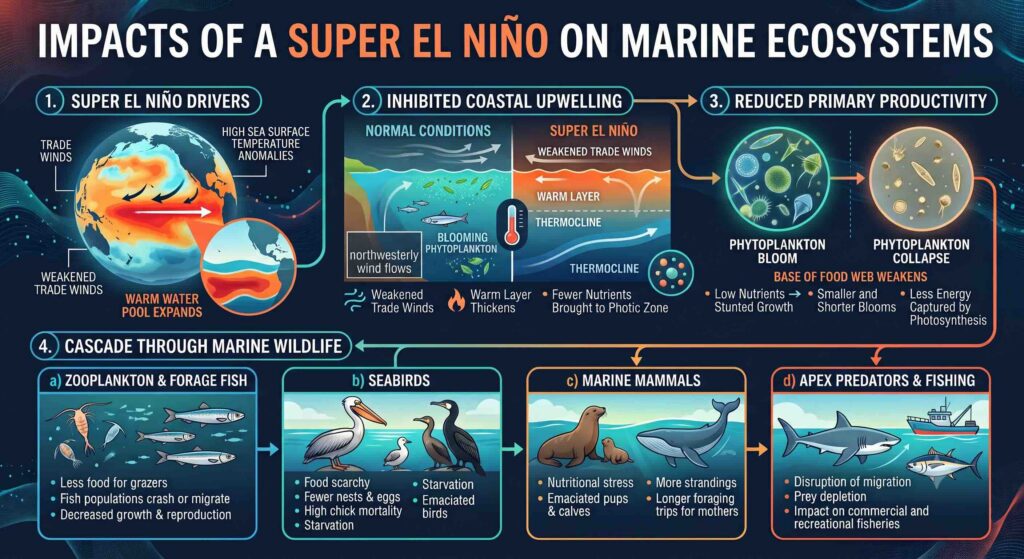
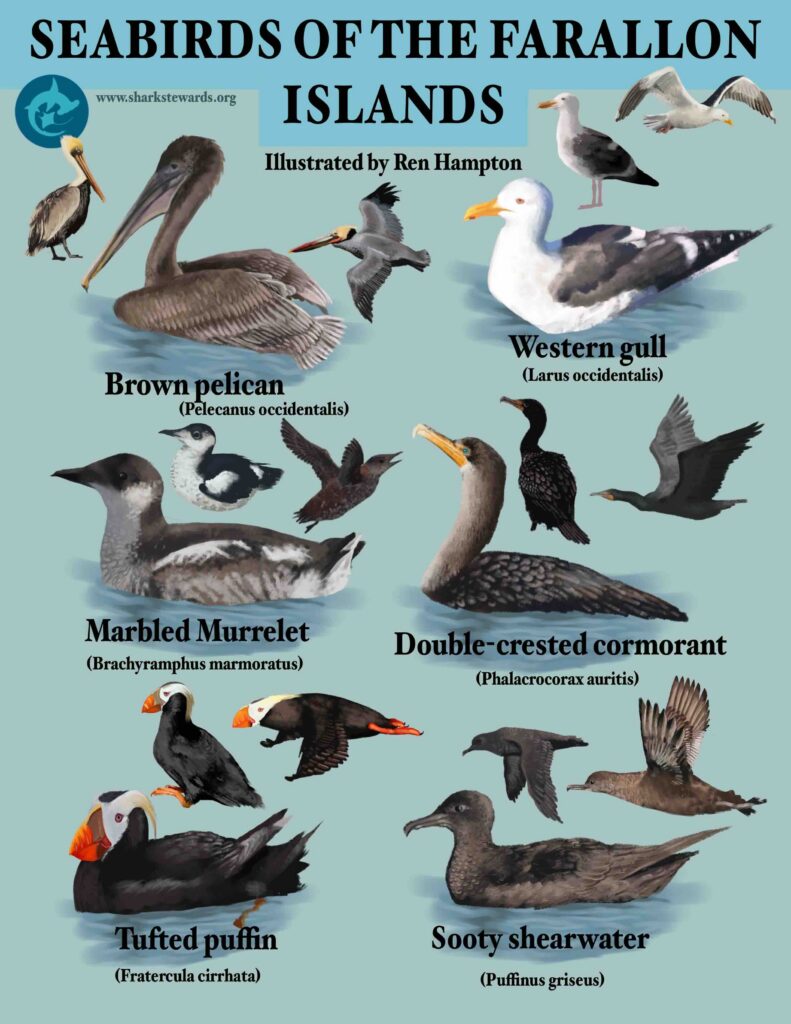
The past major events of 1982–83, 1997–98, and 2015–16 give us a measure of the severity of El Niño stressors on marine wildlife and ecosystems along the central California coastline. The Greater Farallones National Marine Sanctuary is part of the highly productive Point Arena Coastal upwelling ecosystem, and attracts millions of birds, fish, marine mammals and invertebrates to feed and breed. Nearly dead center in the zone, the Farallon Islands off the coast of San Francisco hosts the largest seabird nesting colony in the contiguous United States. During El Niño, starvation forces species like common murres, Cassin’s auklets, and tufted puffins to abandon their nests, leading to massive reproductive failures and adult die-offs. Starvation caused by a lack of food resources have caused large scale die-offs of these and other species, where thousands of emaciated birds wash ashore along the Marin and San Francisco coastlines.
During the 2015 marine heat wave, 62,000 seabirds washed up across California beaches according to the non-profit Point Blue Conservation Science. During strong El Niños, reproductive rates for surface-feeding seabirds can dramatically decline. For example, the Common Murre population on Southeast Farallon Island has suffered a 50% to 90% decline in breeding success during these events.
El Niño events can also spark Marine Mammal Unusual Mortality Events (UMEs). During the 2015–16 event, California sea lion pup strandings along the central coast spiked to over 5 times the historical average due to the starvation-induced failure of maternal nursing routines. Sea lions and harbor seals struggle to find food near the islands. Nursing mothers must forage further and swim deeper to find cold-water pockets, leaving pups unattended for too long, which leads to mass strandings of emaciated pups along the mainland coast.
Warmer waters also support conditions for the proliferation of some plankton species that can create Toxic Algal Blooms. Stagnant, windless, and warmer surface waters create the perfect environment for Harmful Algal Blooms (HABs). Blooms of the dinoflagellate pseudo-nitczhia produce domoic acid, which bioaccumulates up the food chain, poisoning sea lions and forcing early closures of the local Dungeness crab fishery.
Because the offshore waters suffer from severe marine heatwaves, the remaining cool, nutrient-rich water is compressed into a narrow feeding zone right between the islands and the mainland. Humpback and gray whales move dangerously close to this area of high human activity to feed. This overlaps their feeding grounds directly with commercial shipping Dungeness crab gear lines placed primarily along the coastal plane between the coast and the islands can increase whale entanglement rates and the potential for ship strikes.
Along the coast, warm waters and marine heat waves have also taken their toll on kelp forests, which serve as vital feeding grounds, habitat and nurseries for coastal marine life. Over 90% of giant kelp habitat has been lost and these conditions are unlikely to help natural and human assisted recruitment and restoration efforts.
Wildlife protection groups like The Marine Mammal Center, the Sea Bird Stranding Network, the Califoirnia Academy of Sciences (button above) and the government management agency at The Greater Farallones National Marine Sanctuary will all have their hands full this year. We can help by reporting sick or dead wildlife at the numbers linked above and supporting marine protected areas.
Next Article– How Will the Super El Niño Influence California Sharks?
References
7 Ways El Niño and Large Marine Heatwave Could Affect West Coast Marine Species NOAA Fisheries June 12, 2026
El Niño and La Niña Information NOAA National Weather Services https://www.weather.gov/twc/enso
Elliott, M., Lipski, D., Roletto, J., Warzybok, P., and Jahncke, J. 2023. Ocean Climate Indicators Status Report: 2022. Unpublished Report. Point Blue Conservation Science (Contribution No. 2454), Petaluma, CA.
Heather M. Renner et al. Catastrophic and persistent loss of common murres after a marine heatwave. Science 386,1272-1276 (2024).DOI:10.1126/science.adq4330
K. E. Smith, M. T. Burrows, A. J. Hobday, N. G. King, P. J. Moore, A. Sen Gupta, M. S. Thomsen, T. Wernberg, D. A. Smale, Biological impacts of marine heatwaves. Annu. Rev. Mar. Sci. 15, 119–145 (2023).
Central & Northern California Ocean Observing System